Scrolling LED

WELCOME TO MY BLOG

Senin, 28 Februari 2011

Koenigsegg CCX

Koenigsegg CCX
The Koenigsegg CCX is a mid-engined roadster from Swedish car manufacturer Koenigsegg. The CCX has been engineered to comply with the U.S. regulation and market demands and is a newer design that replaced the Koenigsegg CCR.
CCX is an abbreviation for Competition Coupé X; the X commemorating the 10th anniversary (being the Roman numeral for ten) of the completion and test drive of the first CC vehicle in 1996.
The CCX was first unveiled on February 28, 2006 at the 2006 Geneva Motor Show although its existence was announced earlier. A derivative known as the CCXR is available, the main difference being that CCXR's engine is tuned to run on biofuel. The different fuel and tune allows the CCXR to produce 25% more power than the CCX.
Read all? Click This Link : READ ALL

Honda CBR1000RR

Honda CBR1000RR

The CBR1000RR (also known as the Fireblade) is a 999 cc (61.0 cu in) liquid-cooled inline four-cylinder Honda sport bike that was introduced in 2004 to replace the CBR954RR.

Racing roots

The Honda CBR1000RR was developed by the same team that was behind the MotoGP series. Many of the new technologies introduced in the Honda CBR600RR, a direct descendant of the RC211V, were used in the new CBR1000RR such as a lengthy swingarm, Unit Pro-Link rear suspension, and Dual Stage Fuel Injection System (DSFI).
Read all? Click This Link : READ ALL

Sabtu, 26 Februari 2011

McLaren F1

McLaren F1

The McLaren F1 is a super car designed and manufactured by McLaren Automotive. Originally a concept conceived by Gordon Murray, he convinced Ron Dennis to back the project and engaged Peter Stevens to design the exterior of the car. On 31 March 1998, it set the record for the fastest road car in the world, 240 mph (386 km/h). As of Jan 2011, the F1 is still the fastest naturally aspirated road car in the world.
The car features numerous proprietary designs and technologies; it was designed and built with no compromises to the original design concept laid out by Gordon Murray. It is lighter and has a more streamlined structure than even most of its modern rivals and competitors despite having one seat more than most similar sports cars, with the driver's seat located in the middle (and slightly forward of the passengers seating position providing excellent driving visibility). It features a powerful engine and is somewhat track oriented, but not to the degree that it compromises everyday usability and comfort. It was conceived as an exercise in creating what its designers hoped would be considered the ultimate road car. Despite not having been designed as a track machine, a modified race car edition of the vehicle won several races, including the 24 Hours of Le Mans in 1995, where it faced purpose-built prototype race cars. Production began in 1992 and ended in 1998. In all, 106 cars were manufactured, with some variations in the design.
In 1994, the British car magazine AutoCar stated in a road test regarding the F1, "The McLaren F1 is the finest driving machine yet built for the public road." and that "The F1 will be remembered as one of the great events in the history of the car, and it may possibly be the fastest production road car the world will ever see.".
Read all? Click This Link : READ ALL

Pagani Zonda

Pagani Zonda
The Pagani Zonda is a mid-engined sports car produced by Pagani in Italy. It debuted in 1999 and continues through the present, with production proceeding at roughly 17-19 cars per year. As of June 2009, 206 Zondas had been built, including test mules. Both 2-seat coupe and convertible versions have been produced. Construction is mainly of carbon fiber.
Some of the early Zonda engineering was done by Formula One champion Juan Manuel Fangio. The car was originally to be named the "Fangio F1" after him but, following his death in 1995, it was renamed for an air current above Argentina.
Read all? Click This Link : READ ALL

Jumat, 25 Februari 2011

Lamborghini Diablo

Lamborghini Diablo

The Lamborghini Diablo is a high-performance mid-engined sports car that was built by Italian automaker Lamborghini between 1990 and 2001. It was the first Lamborghini capable of attaining a top speed in excess of 200 miles per hour (320 km/h). After the end of its production run in 2001, the Diablo was replaced by the Lamborghini Murciélago.
Read all? Click This Link : READ ALL

Ferrari 458 Italia

 Ferrari 458 Italia
The Ferrari 458 Italia is a mid-engined sports car produced by the Italian sports car manufacturer Ferrari. The 458 Italia replaces the Ferrari F430. The 458 Italia was officially unveiled at the 2009 Frankfurt Motor Show on 15 September 2009.
In Ferrari's first official announcement of the car, the 458 Italia was described as the successor to the F430 but arising from an entirely new design, incorporating technologies developed from the company's experience in Formula 1.

Engine

The 458 Italia is powered by a 4,499 cc (4.499 L; 274.5 cu in) V8 engine derived from a shared Ferrari/Maserati design, producing 570 PS (420 kW; 560 hp) at 9,000 rpm (redline) and 540 N·m (400 lb·ft) at 6,000 rpm with 80% torque available at 3,250 rpm. The engine features direct fuel injection, which is a first for Ferrari mid-rear engine setups in its road cars.

Transmission

The standard transmission is a Getrag dual-clutch 7-speed transmission, similar to the Ferrari California. There is no traditional manual option, making this the fourth road-car after the Enzo, Challenge Stradale and 430 Scuderia not to be offered with Ferrari's classic gated manual. It is the first mainstream model to not be offered with a manual transmission.
Read all? Click This Link : READ ALL

Suzuki Hayabusa GSX1300R

 Suzuki Hayabusa GSX1300R

The Suzuki Hayabusa (or GSX1300R) is a sport bike motorcycle made by Suzuki since 1999. It immediately won acclaim as the world's fastest production motorcycle, with a top speed of 188–194 miles per hour (303–312 km/h).
Hayabusa (?) is Japanese for "peregrine falcon", a bird that often serves as a metaphor for speed due to its vertical hunting dive, or stoop, speed of 180 to 240 miles per hour (290 to 390 km/h), the fastest of any bird. In particular, the choice of name was made because the peregrine falcon preys on blackbirds, which reflected the intent of the original Hayabusa to unseat the Honda CBR1100XX Super Blackbird as the world's fastest production motorcycle. Eventually, the Hayabusa managed to surpass the Super Blackbird by at least a full 10 miles per hour (16 km/h).
In 2000, fears of a European regulatory backlash or import ban led to an informal agreement between the Japanese and European manufacturers to govern the top speed of their motorcycles at an arbitrary limit.
The media-reported value for the speed agreement in miles per hour was consistently 186 mph, while in kilometers per hour it varied from 299 to 303 km/h, which is typical given unit conversion rounding errors. This figure may also be affected by a number of external factors, as can the power and torque values.
The conditions under which this limitation was adopted led to the 1999–2000 Hayabusa's title to remain, at least technically, unassailable, since no subsequent model could go faster without being tampered with. Thus, after the much anticipated. Kawasaki Ninja ZX-12R of 2000 fell 4 mph (6 km/h) short of claiming the title, the Hayabusa secured its place as the fastest standard production bike of the 20th century. This gives the unrestricted 1999–2000 models even more cachet with collectors.
Besides its speed, the Hayabusa has been lauded by many reviewers for its all-around performance, in that it does not drastically compromise other qualities like handling, comfort, reliability, noise, fuel economy or price in pursuit of a single function. Jay Koblenz of Motorcycle Consumer News commented, "If you think the ability of a motorcycle to approach 190 mph or reach the quarter-mile in under 10 seconds is at best frivolous and at worst offensive, this still remains a motorcycle worthy of just consideration. The Hayabusa is Speed in all its glory. But Speed is not all the Hayabusa is.
Read all? Click this Link : READ ALL

Kamis, 24 Februari 2011

Lamborghini Murchiélago

Lamborghini Murciélago

Top 10 List Fastest Cars in the World

Fastest Cars In The World: Top 10 List 2010-2011

World's Fastest Cars

While most of us can only dream of owning the fastest car in the world, some will do whatever it takes to possess such speed and power. So, how fast are the fastest cars in the world? Here are the 10 fastest cars available on the market measures by top speed.
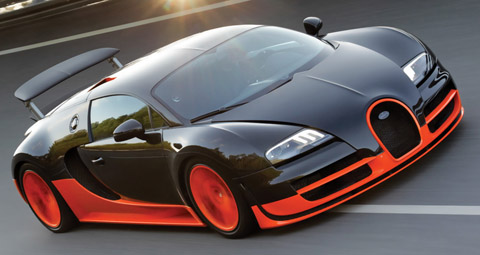
1. Bugatti Veyron: 267 mph, 0-60 in 2.5 secs. Aluminum, Narrow Angle 8 Liter W16 Engine with 1200 hp, base price is $1,700,000. Tested again on July 10, 2010 with the new 2010 Super Sport Version, the Bugatti Veyron once again claimed its title as the fastest car in the world at 267 mph.

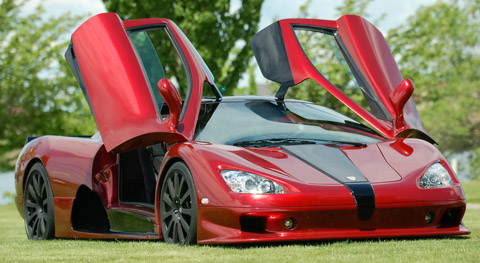
2. SSC Ultimate Aero: 257 mph, 0-60 in 2.7 secs. Twin-Turbo V8 Engine with 1183 hp, base price is $654,400. Tested in March 2007 by Guinness World Records, The SSC Ultimate Aero was the fastest car in the world from March 2007 to July 2010 until recently it fell behind the Bugatti Veyron to take the #2 spot.
SSC Ultimate Aero Red doors open
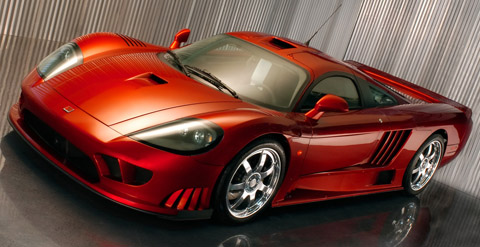
3. Saleen S7 Twin-Turbo: 248 mph, 0-60 in 3.2 secs. Twin Turbo All Aluminum V8 Engine with 750 hp, base price is $555,000. Smooth and bad-ass, will make you want to show it off non-stop.
Saleen S7 Twin Turbo dark orange front view
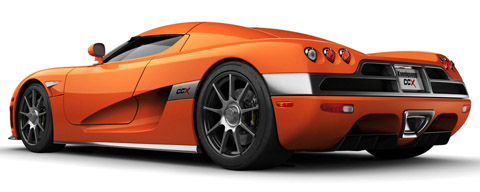
4. Koenigsegg CCX: 245 mph, 0-60 in 3.2 secs. 90 Degree V8 Engine 806 hp, base price is $545,568. Made in Sweden, it is aiming hard to be the fastest car in the world, but it has a long way to go to surpass the Bugatti and the Ultimate Aero.
Orange Koenigsegg CCX
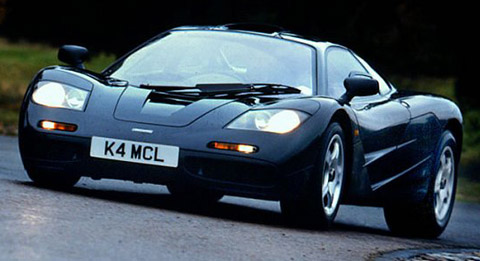
5. McLaren F1: 240 mph, 0-60 in 3.2 secs. BMW S70/2 60 Degree V12 Engine with 627 hp, base price is $970,000. Check out the doors, they looks like bat wings, maybe Batman need to order one and paints it black 1997 McLaren F1 on the road black
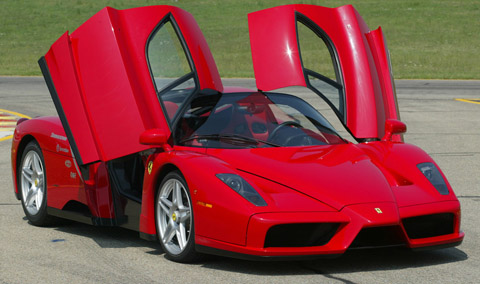
6. Ferrari Enzo: 217 mph, 0-60 in 3.4 secs. F140 Aluminum V12 Engine with 660 hp, base price is $670,000. Only 399 ever produced, the price goes up every time someone crashes.Ferrari Enzo doors open front view
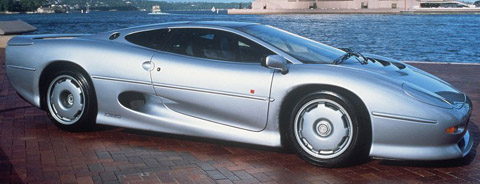
7. Jaguar XJ220: 217 mph, 0-60 in 3.8 secs. Twin Turbo V6 Engine with 542 hp, base price was $650,000. Made in 1992, this car still got what it takes to make the list.
Jaguar XJ220
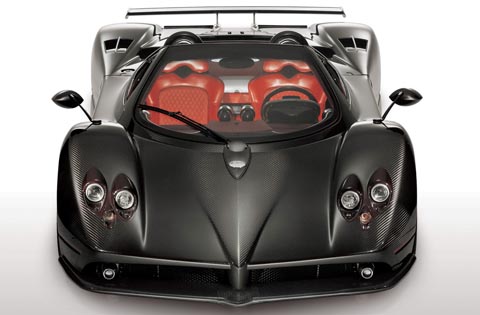
8. Pagani Zonda F: 215 mph, 0-60 in 3.5 secs. Mercedes Benz M180 V12 Engine with 650 hp, base price is $667,321. With a V12 motor, this baby can do much better.pagani zonda f
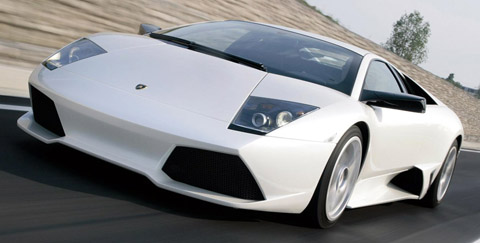
9. Lamborghini Murcielago LP640: 211 mph, 0-60 in 3.3 secs. V12 Engine with 640 hp, base price is $430,000. Nice piece of art, the design is very round and smooth.
White Lamborghini Murcielago front view
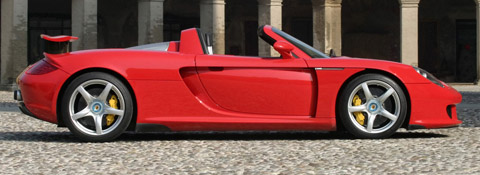
10. Porsche Carrera GT: 205 mph, 0-60 in 3.9 secs. Aluminum, 68 Degree, Water Cooled V10 Engine with 612 hp, base price is $440,000. The most powerful and most expensive Porsche  nearly made the list as #10.
Red Porsche Carrera GT side view

Bugatti Veyron

 BUGATTI VEYRON

The Bugatti Veyron EB 16.4 is a rear mid-engined supercar. It is the most expensive modern car in the world at $1,600,000. The Super Sport version is the fastest road-legal car in the world, with a top speed of 431.07 km/h (267.85 mph). The original version has a top speed of 408.00 km/h (253.52 mph).
Designed and developed by the German Volkswagen Group and produced by Bugatti Automobiles SAS at their headquarters in Château St. Jean in Molsheim (Alsace, France), the Veyron's chief designer was Hartmut Warkuss, and the exterior was designed by Jozef Kabaň of Volkswagen, with much of the engineering work being conducted under the guidance of former Peterbilt engineer and now Bugatti Engineering chief Wolfgang Schreiber.
The car is named after French racing driver Pierre Veyron, who won the 24 hours of Le Mans in 1939 while racing for the original Bugatti company. It was named Car of the Decade (2000–2009) by the BBC television programme Top Gear.
A number of special variants have been produced, including two targa tops. In December 2010, Bugatti began offering prospective buyers the ability to customize exterior and interiors colors by using the Veyron 16.4 Configurator application on the marque's official website.
The Veyron features an 8.0 litre W16 engine with sixteen cylinders in four banks of four, equivalent to two narrow-angle V8 engines mated in a W configuration. Each cylinder has four valves for a total of sixty four, but the narrow staggered V8 configuration allows two overhead camshafts to drive two banks of cylinders so only four camshafts are needed. The engine is fed by four turbochargers and displaces 7,993 cubic centimetres (487.8 cu in), with a square 86 by 86 mm (3.4 by 3.4 in) bore and stroke.
The transmission is a dual-clutch direct-shift gearbox computer-controlled automatic with seven gear ratios, with magnesium paddles behind the steering wheel and a shift time of less than 150 milliseconds, built by Ricardo of England rather than Borg-Warner, who designed the six speed DSG used in the mainstream Volkswagen Group marques. The Veyron can be driven in either semi- or fully-automatic mode. A replacement transmission for the Veyron costs just over $120,000. It also has permanent four wheel drive using the Haldex Traction system. It uses special Michelin PAX run flat tires, designed specifically to accommodate the Veyron's top speed, which reportedly cost $25,000 US per set. The tires can be removed from the rims only in France, a service which reportedly costs $70,000. Curb weight is 2,034.8 kilograms (4,486 lb). This gives the car a power to weight ratio, according to Volkswagen Group's 1,001 metric horsepower (736 kW; 987 bhp) figures, of 446.3 metric horsepower (328 kW; 440 bhp) per ton.
The car's wheelbase is 2,710 mm (106.7 in). Overall length is 4,462 mm (175.7 in), width 1,998 mm (78.7 in) and height 1,204 mm (47.4 in).

The Veyron's hydraulic rear spoiler in the extended position
The Bugatti Veyron has a total of ten radiators.
  • 3 heat exchangers for the air-to-liquid intercoolers.
  • 3 engine radiators.
  • 1 for the air conditioning system.
  • 1 transmission oil radiator.
  • 1 differential oil radiator.
  • 1 engine oil radiator.
It has a drag coefficient of 0.41 (normal condition) and 0.36 (after lowering to the ground), and a frontal area of 2.07 square metres (22.3 sq ft). This gives it a drag area - the combination of drag coefficient and frontal area, represented as CdA - of 0.74 m2 (8.0 sq ft).